Could Irma Become a 5 Again
Hurricane Irma Synopsis
Hurricane Irma was a classic Cape Verde hurricane that will long be remembered for its severity and broad-ranging impacts to several islands in the Caribbean Ocean and Florida. Similar many of the most notorious Atlantic hurricanes, Irma began as a weak wave of low force per unit area accompanied by disorganized showers and thunderstorms which emerged off the west African coast on August 27th, near the top of the Atlantic hurricane flavor (Fig. i). Such disturbances move off the African coast every few days during August and September, however, nearly of them neglect to develop into tropical cyclones. This can be due to a number of factors, including blasts of dry out, stable air from the Saharan desert, strong upper-level westerly winds, or a lack of the necessary atmospheric "spin" needed to generate a counterclockwise circulation.
In late August and early September, nonetheless, the atmospheric and oceanic atmospheric condition in the tropical Atlantic were favorable for tropical cyclone development. Body of water surface temperatures were above boilerplate (more often than not in the lower to mid 80s F beyond the tropical Atlantic), and at that place was an area of light winds in the upper temper, which immune the developing storm circulation to grow vertically deep (Fig. two).
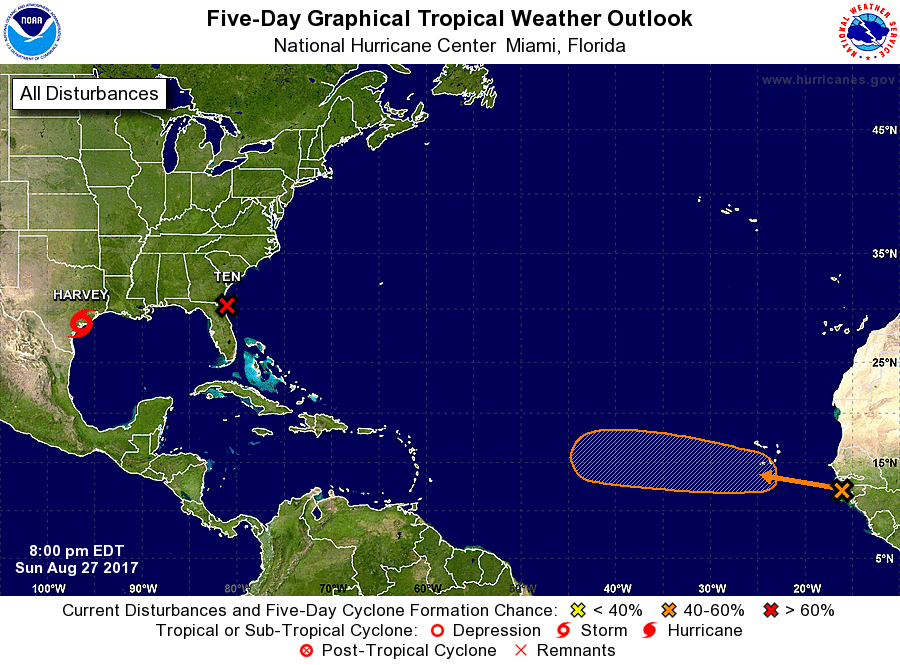 |
| Fig. ane National Hurricane Center'due south 5-day forecast probability for a tropical disturbance emerging off the west African coast on Baronial 27th. Prototype courtesy of NHC. |
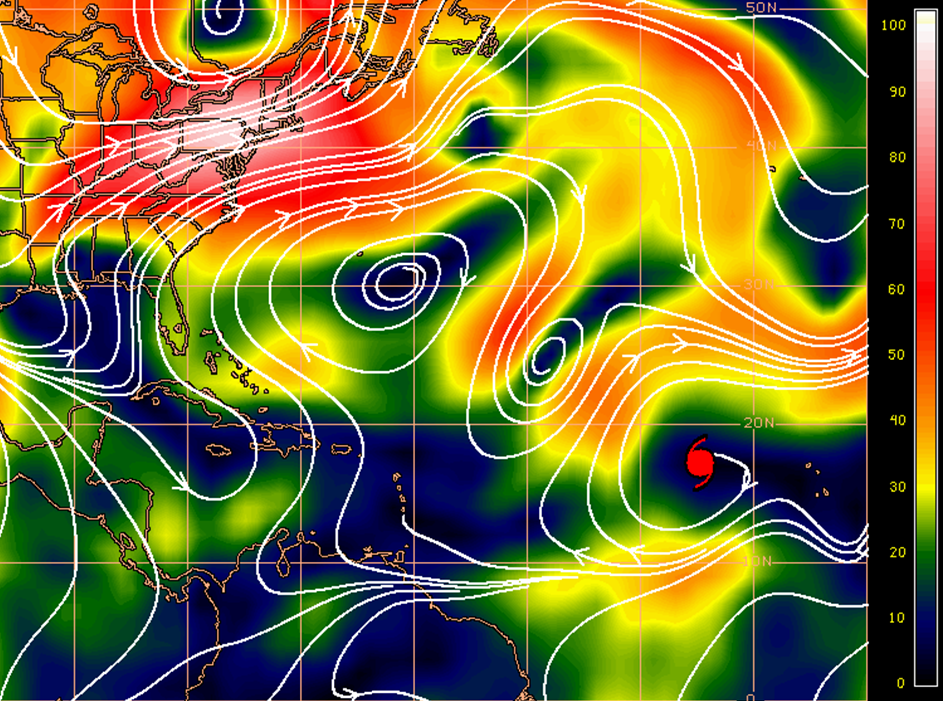 |
| Fig. two Upper-level flow (white lines with arrows), based on satellite estimates of 200 mb winds (40,000 ft AGL). Image is vertical wind shear in knots, with black and dark blueish being nearly favorable for tropical whirlwind intensification (i.eastward. light wind shear). Hurricane Irma shown using red hurricane symbol. Epitome courtesy of UW CIMSS. |
Tropical Storm Irma formed in the far eastern Atlantic Sea, simply w of the Cape Verde Islands, on the morning of August xxxth. Over the following thirty hours Irma intensified into a major hurricane with highest sustained winds of 115 MPH, a category-3 storm on the Saffir-Simpson Hurricane Wind Scale. Such rapid strengthening is unusual for storms in the far eastern Atlantic. Irma'due south intensity remained fairly steady for the next few days while moving into a region with drier air aloft (Fig. 3)
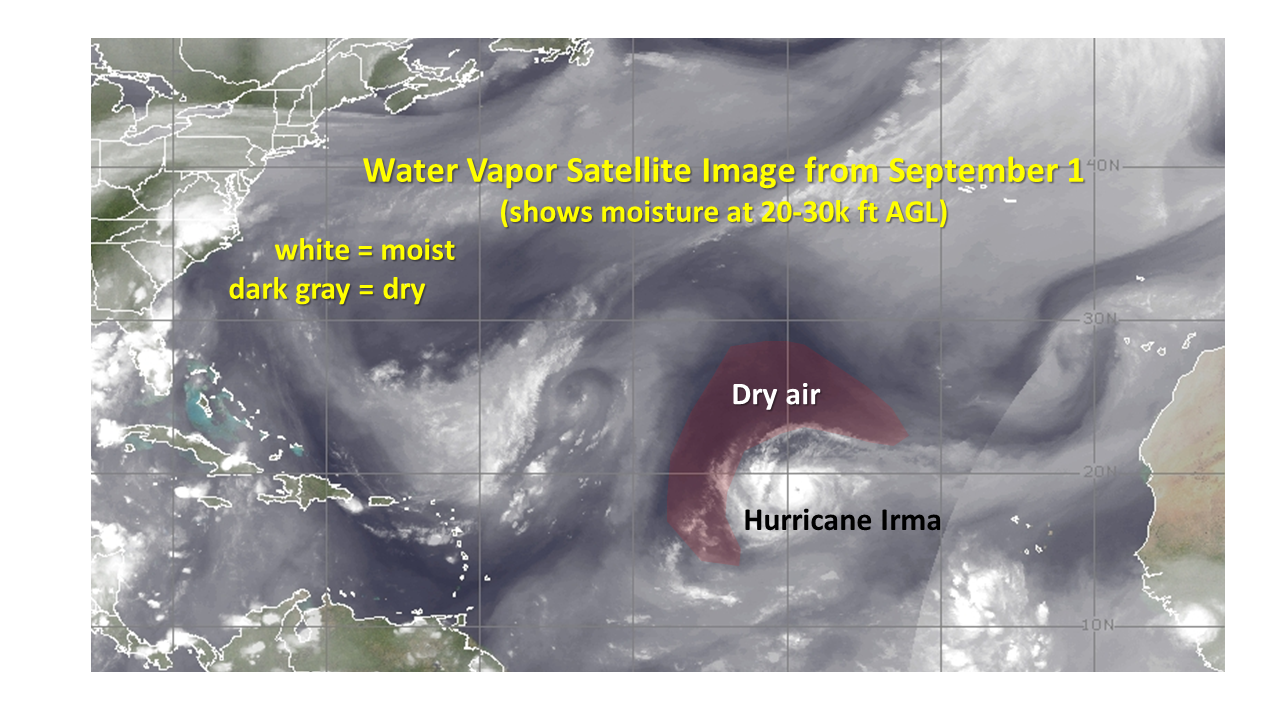 |
| Fig. three Water vapor image. Image courtesy of UW CIMSS. |
As Irma began to approach the northern Leeward Islands on September 4th and 5th, the hurricane chop-chop intensified while moving over warmer h2o and into a more moist atmosphere. The storm became a rare category-five hurricane on September fiveth, with maximum sustained winds of 185 MPH. This made Irma the strongest hurricane ever observed in the open Atlantic Ocean, and one of simply 5 hurricanes with measured winds of 185 MPH or higher in the entire Atlantic basin. Over the next few days Irma continued moving w, passing through the northeast Leeward Islands, Virgin Islands, and just north of the islands of Puerto Rico and Hispaniola, while maintaining its category-5 winds. While category-5 hurricanes are rare, it is even more rare for such storms to maintain this status for such a long period of time. Irma was a category-five hurricane for 3 days (Fig. 4).
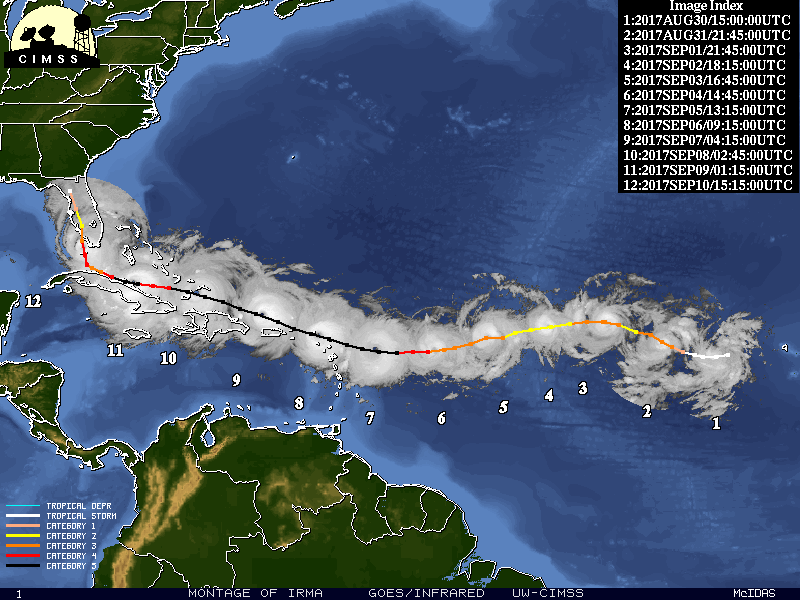 |
| Fig. four Satellite montage of Irma using GOES IR images and NHC advisories. Courtesy of UW CIMSS. |
While it will take fourth dimension to realize all of the impacts from Irma, some were immediately apparent, fifty-fifty from infinite. Fig. 5 shows the massive defoliation across some of the Virgin Islands which were struck by Irma at elevation intensity. The islands, which used to appear dark-green to the special satellite sensor due to their dense coverage of plants and trees, are now brown.
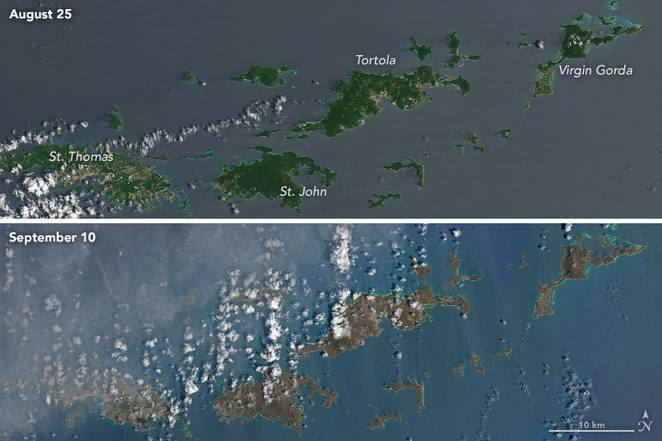 |
| Fig. 5 NASA'southward landsat-8 satellite images, before & after Irma. |
The tempest finally "weakened" to a category-four hurricane on September 8th, but withal had devastating winds of 155 MPH while moving through the southern Bahamas. Irma intensified to a category-five level once again that evening, with height winds of 160 MPH, as information technology approached the northern declension of Cuba. Irma moved due west along or simply inland from the northern coast of Cuba on September 9th. This interaction with country disrupted Irma's structure a bit, every bit a hurricane requires plenty of deep warm water beneath the storm's center to maintain the extremely depression pressure and strong winds. Thus Irma weakened slightly to a category-3 hurricane with winds of 125 MPH.
For many days Irma had been steered steadily westward beyond the tropical Atlantic and Caribbean area islands by a potent ridge in the mid to upper temper (10k to 30k ft AGL) to Irma's north. The numerical weather prediction models, which are used past forecasters to help them predict the future runway and intensity of hurricanes, had consistently forecast this ridge to weaken somewhere effectually Florida. Nevertheless, these models differed equally to exactly when or where this would occur, so that Irma'south forecast tracks ranged from just off the east coast of Florida to the extreme eastern Gulf of United mexican states. This breakdown in the high pressure ridge finally began to develop September 9th, and Irma made its much anticipated plow to the northwest, into the Florida Straits (Fig. vi).
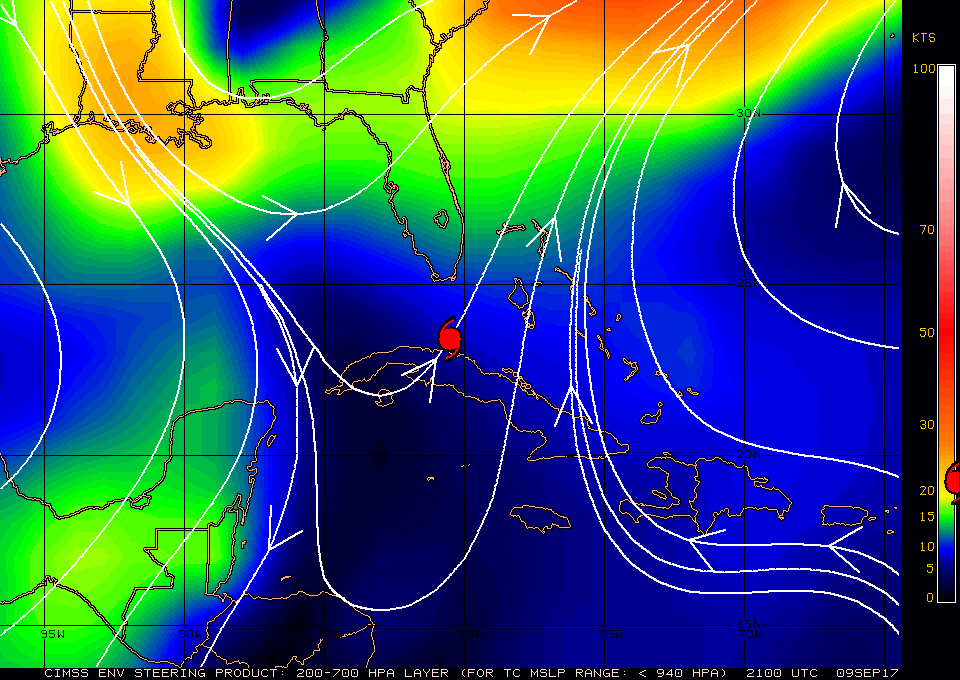 |
| Fig. 6 Estimated steering currents for Hurricane Irma on the afternoon of September 9th. White lines with arrows betoken direction of steering, image indicates forward speed. Note Irma'southward location over the north declension of Cuba, between the Bermuda ridge to the east and a ridge over the western Gulf of Mexico. The mid-upper trough between these ridges steered Irma to the northwest, and then n. Prototype courtesy of UW CIMSS. |
Resilient Irma made a final attempt to re-intensify while crossing the open waters of the Florida Straits. The storm quickly reached category-iv intensity with 130 MPH winds early on in the morning of September 10thursday, while approaching the vulnerable Florida Keys. Fortunately for much of the rest of Florida, Irma finally began to encounter unfavorable atmospheric weather for hurricanes. The shear, which had been so light for and then long, was chop-chop increasing in Irma's path as a trough of depression pressure developed in the Gulf of United mexican states (Fig. vii). Additionally, dry air associated with this trough was outset to disrupt Irma'south inner core.
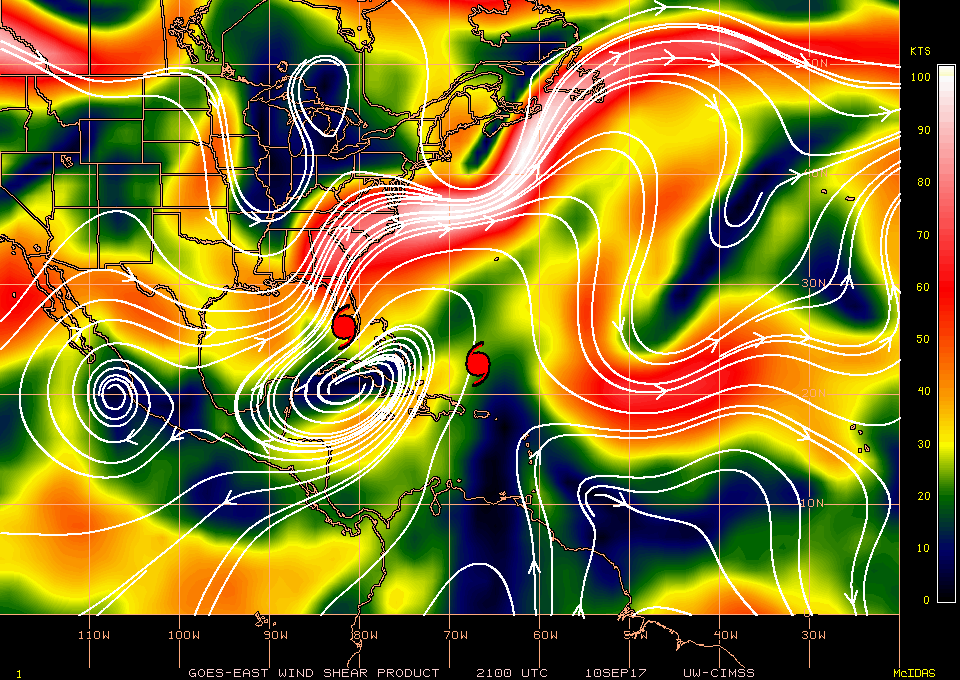 |
| Fig. 7 Upper-level flow (white lines with arrows), based on satellite estimates of 200 mb winds (40,000 ft AGL). Prototype is vertical wind shear in knots, with yellows and reds being unfavorable for tropical cyclones (i.e. potent wind shear). Note Irma'south location over southwest Florida on the afternoon of September 10th. Image courtesy of UW CIMSS. |
The major hurricane fabricated landfall near Marco Island in southwest Florida around 3 pm EDT on September 10th, as a category-iii tempest with 115 MPH. Naples, Florida reported a peak wind gust of 142 MPH. Irma moved quickly northward, merely inland from the w coast of Florida on September xthursday and 11th. When Irma starting time developed in the far eastern Atlantic, despite its strength, its wind field was quite small. Equally the storm approached Florida, however, its current of air field expanded dramatically. Every bit Irma striking Florida, tropical storm forcefulness winds extended outward up to 400 miles from the centre, and hurricane force winds extended up to lxxx miles. Hurricane force wind gusts (i.e. 74 MPH or more) were reported along much of the due east coast of Florida, from Jacksonville to Miami. In addition to the long periods of heavy rain and potent winds, storm surge flooding likewise occurred well away from the storm middle, including the Jacksonville area, where strong and persistent onshore winds had been occurring for days before Irma's centre made its closest approach.
By the time the minimal hurricane reached northwest Florida (on the morning of September xith), the wind gusts across south Georgia and northwest Florida were generally in the 45 to 60 MPH range (Fig. eight). Atmospheric condition improved apace once the storm center passed by as stiff, dry out southwest winds aloft made the arrangement asymmetric, with nearly all of the pelting and nigh of the strongest winds existence along and due north of the poorly-divers center. Irma weakened to a tropical tempest in due south Georgia in the afternoon, and further into a tropical depression while moving north beyond central Georgia in the evening.
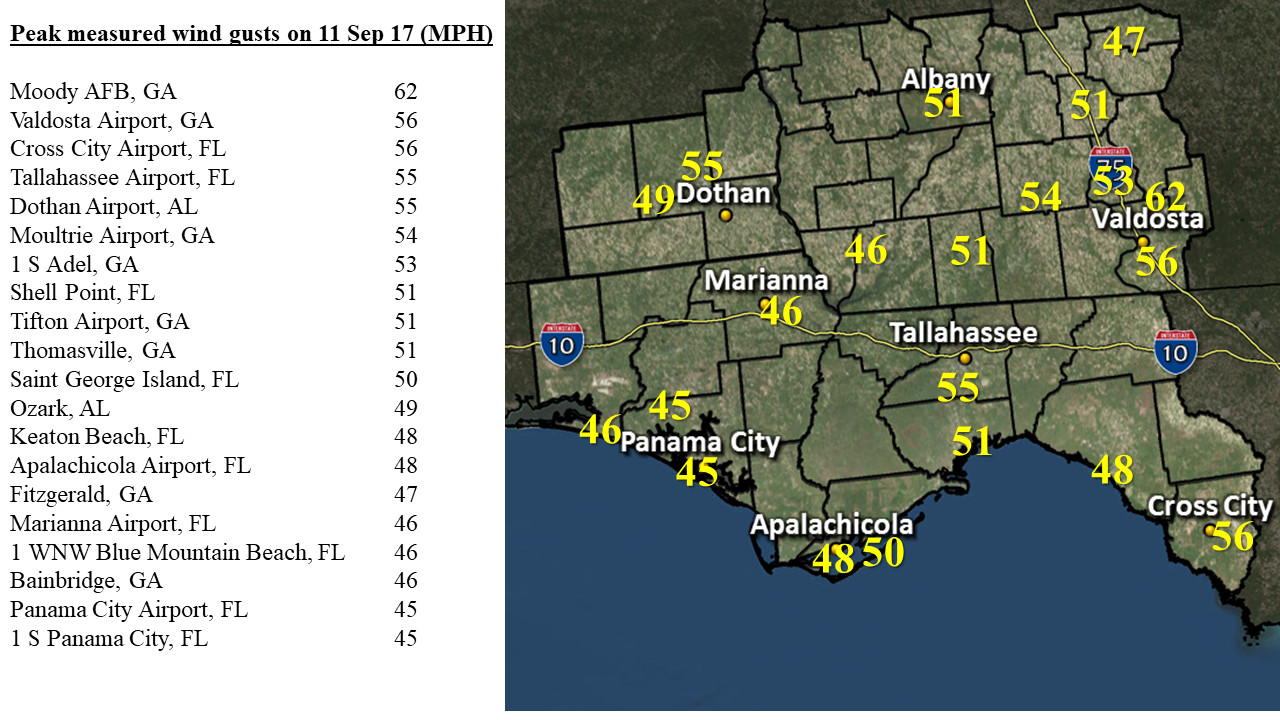 |
| Fig. 8 Measured local wind gusts associated with Irma. |
The residents of northwest Florida and southward Georgia were fortunate compared to much of the rest of Florida. Had Irma taken its turn to the due north slightly afterwards, the center of Irma would have remained offshore the Florida west declension. Irma would yet have weakened due to the increasingly unfavorable atmospheric weather, but this weakening tendency may have been slower with the center even so over the warm waters of the eastern Gulf of United mexican states. A slightly more than western track could likewise accept allowed for a brief period of onshore winds in Apalachee Bay, increasing the risk for tempest surge. Irma'southward track to the e of Tallahassee resulted in a prolonged period of strong offshore winds, which actually kept the tides in Apalachee Bay lower than normal for much of the issue (Fig. 9).
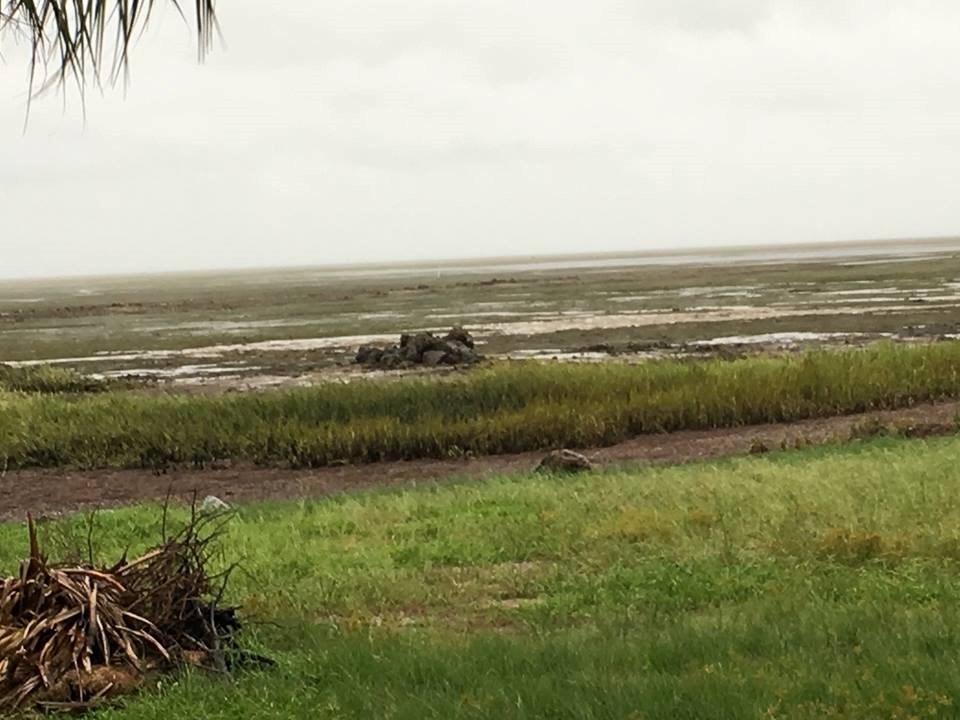 |
| Fig. ix Picture taken by Taylor County Emergency Manager showing the coast of Taylor County on the morning of September 11th. During this time the strong offshore winds actually acquired below-normal tides forth the declension of Apalachee Bay. In this film, the Gulf of United mexican states waters, which commonly covers much of the area shown, appear far away. The tide did come later in the day as the winds shifted from north to west after the passage of Irma'southward center, but no significant flooding was reported. |
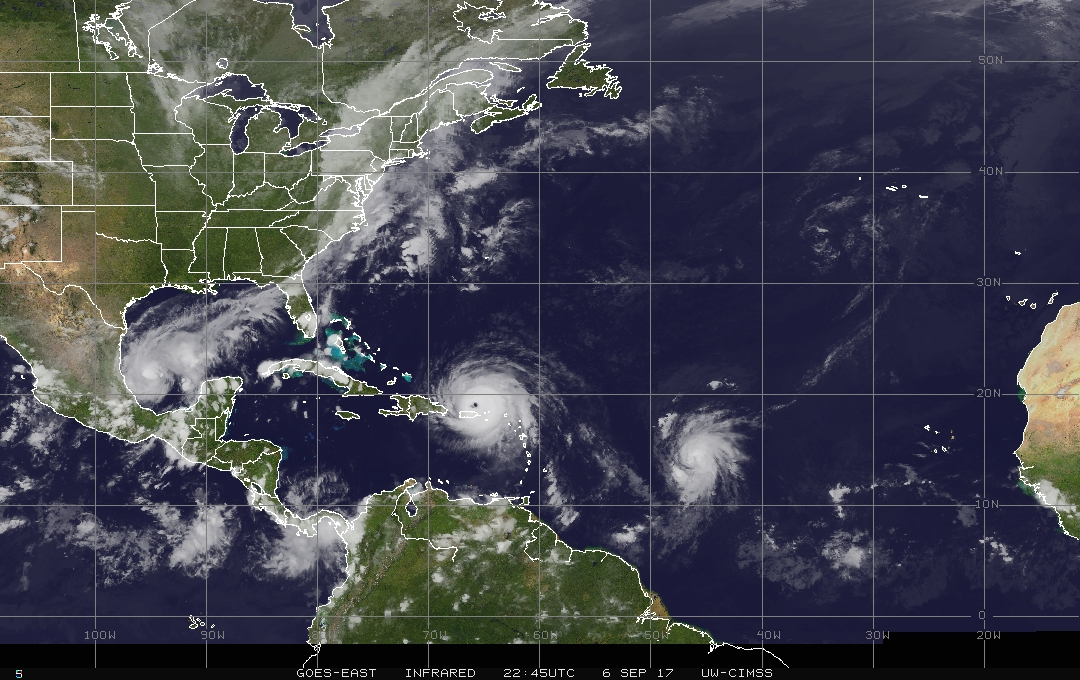 |
| Fig. 10 Satellite IR image showing Hurricane Irma, ane of the strongest hurricanes always in the Atlantic basin, near peak intensity on the afternoon of September vith, just north of Puerto Rico. Maximum sustained winds are 185 MPH, and central pressure is 914 mb on the 5 pm EDT NHC informational. Paradigm courtesy of UW CIMSS. |
Coldest clouds are shown in white, warmest surface temperatures in blue. Note the perfectly circular cloud pattern, the warm spot (the center of the hurricane, where the satellite sensor can "see" to the warm ocean surface) surrounded by the symmetrical ring of extremely common cold (tall) thunderstorm deject tops, and the fanning out of thin, loftier-level clouds indicative of air being evacuated from the core of the storm. This is a textbook image of how an intense hurricane appears in a low shear, moist atmosphere with very warm water below.
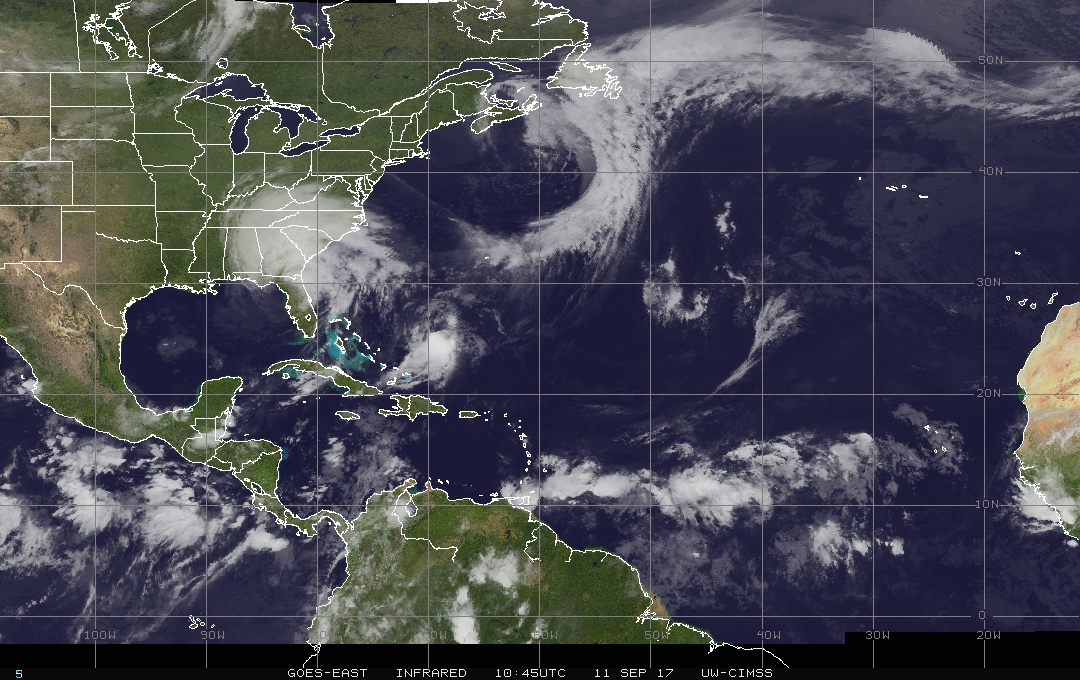 |
| Fig. 11 Satellite IR paradigm showing the heart of Hurricane Irma, as a minimal hurricane, along the northwest Florida coast only inland from Cedar Key early in the morning of September eleventh. Maximum sustained winds are 75 MPH, and fundamental force per unit area is 965 mb on the 5 am EDT NHC advisory. Prototype courtesy of UW CIMSS. |
Note how the coldest deject tops (white) are n and east of the storm center. This is due to strong current of air shear (from stiff southwest winds in the upper temper), and dry out air in the mid and upper levels of the atmosphere wrapping into the tempest, and the fact that the hurricane'south center had been over land for at to the lowest degree 12 hours.
Source: https://www.weather.gov/tae/Irma_technical_summary
0 Response to "Could Irma Become a 5 Again"
Post a Comment